
How to Check Criminal History in Cooperstown
No single Cooperstown search covers police reports, local dockets, county custody, and statewide history. First read the appearance ticket, release paper, or receipt for the agency and court name. That clue matters because Village Police cannot release a Sheriff's booking file, and a village clerk cannot certify a criminal disposition held by a court.
- Call Cooperstown Police for a report created by a village officer.
- Send a specific FOIL request through the village records-access route for releasable police material.
- Confirm the court on the papers through the New York Court Locator, then ask that clerk for the docket or disposition.
- Call Otsego County Corrections if the person may be in county custody, and County Court if a felony moved there.
- Use OCA CHRS for statewide public court history or DCJS review for your own fingerprint record.
This sequence keeps Cooperstown criminal history tied to the correct source. Each response covers only what that office creates or maintains.
Cooperstown Police Records at Village Hall
Cooperstown Police works from 22 Main Street, using the Fair Street entrance to the basement of the Village Library. The nonemergency line is 607-547-2500. An officer is not always present, so arrange contact rather than assuming the records counter is staffed. Emergencies use 911. This small-department setup makes a focused call or written request more useful than an unplanned visit.
The official Cooperstown Police page provides the village department's contact and policy material.
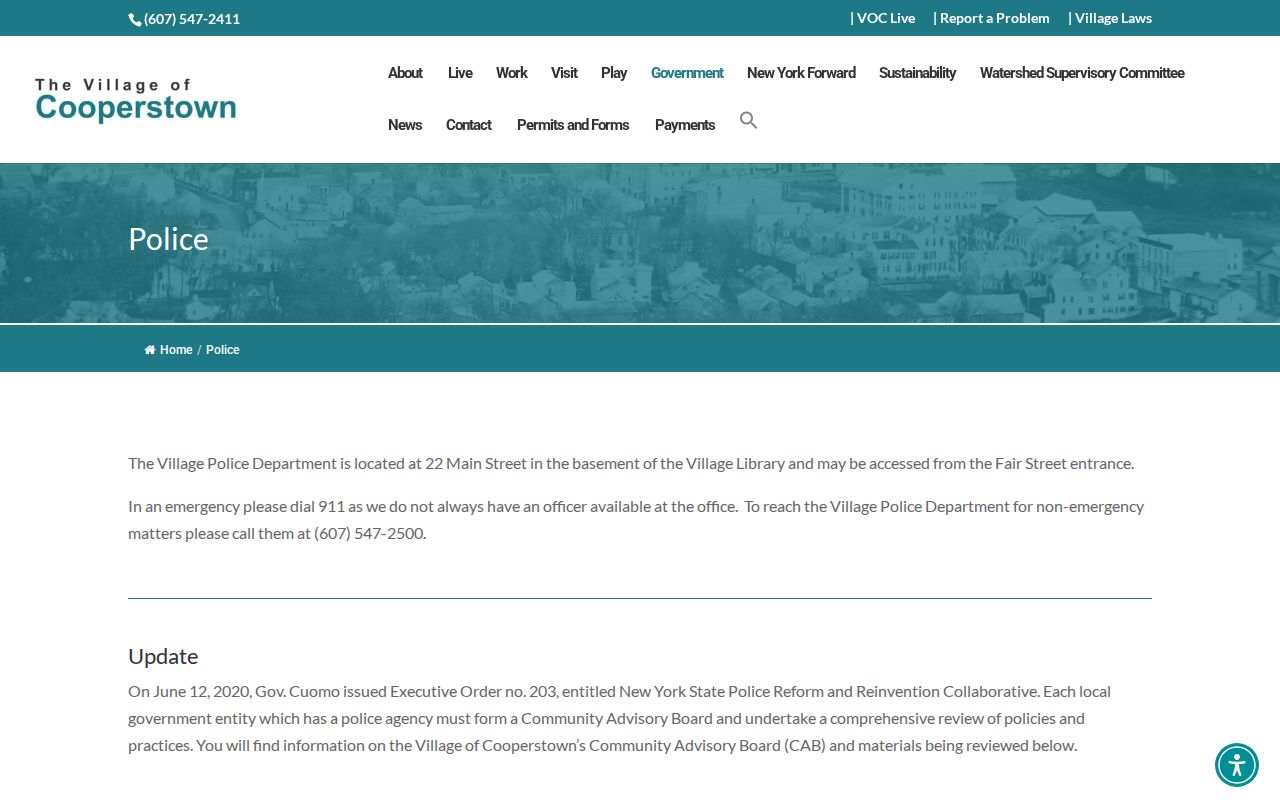
The village page confirms the local police source, but it does not provide a person-name arrest index or complete Cooperstown blotter.
The Cooperstown Police Department
Cooperstown Police keeps reports for incidents and arrests handled by village officers. A useful request names the report or media sought, date and time range, location, people involved, and incident number if known. Ask for an incident report, arrest report, photograph, or a defined camera segment instead of asking the village to compile every reference to a name. FOIL applies to existing agency records and does not compel new analysis.
The village may redact or withhold parts that implicate an active case, fair-trial rights, personal privacy, confidential sources, safety, juvenile confidentiality, or sealing. A Cooperstown police allegation also remains distinct from the charge prosecutors filed. Compare the report with the court's accusatory instrument and disposition before drawing a conclusion.
Requesting Cooperstown Police Camera Records
Cooperstown publishes both fixed-camera and body-worn-camera policy material. The fixed-camera policy describes continuous recording, controlled investigative access to archived images, and a FOIL route for outside requests with allowable retrieval or reproduction cost. The body-camera policy states that recordings belong to the village and limits dissemination. A policy explains creation and handling, but it is not a promise that every requested clip will be released.
Identify the date, narrow time window, location, officer or incident number, and the type of recording. The village may need to review and redact the segment. If another agency also responded, that agency controls its own recording. The Sheriff FOIL form cannot substitute for a Cooperstown Police camera request merely because both agencies work in Otsego County.
Note: A camera policy can confirm that footage may exist, while FOIL and the case status control public access to the actual recording.
Arrests and Bookings in Cooperstown
Cooperstown does not maintain a separate public jail roster. A person detained after a village arrest enters Otsego County Corrections at 172 County Highway 33W. Call 607-547-4252 for current custody. The police report stays with the village, the booking entry belongs to the Sheriff, and the filed charges remain with the court named in the accusatory papers.
Do not search the New York State Department of Corrections and Community Supervision for a fresh village arrest. DOCCS covers state imprisonment, not pretrial detention in the Otsego County jail. VINE can provide custody status and notifications, but it is not a court docket. The county arrest history page gives the complete local channel sequence when the booking route needs more depth.
Cooperstown Criminal Records at 197 Main
Cooperstown's county-seat role concentrates several Otsego County offices at 197 Main Street. County Court occupies Suite 9. The County Clerk, District Attorney, Public Defender, and Probation Department work in the same complex. Those offices have different duties, even though they share an address. County Court holds felony dockets, while the County Clerk describes its permanent-record and court-register responsibilities. Prosecutors and defenders are not general public-record search counters.
The official Otsego County Clerk page identifies the county's permanent-record office in Cooperstown.
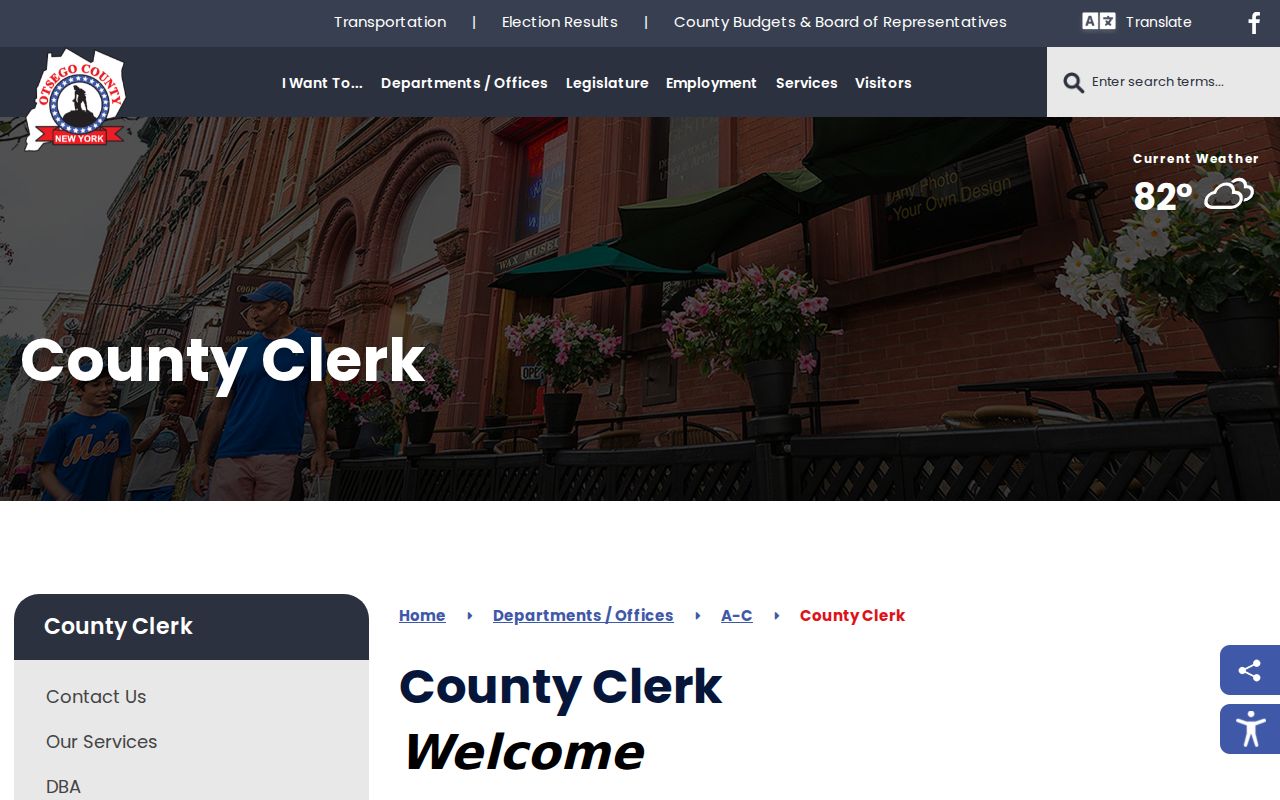
This county office illustrates why Cooperstown searches must distinguish village records from county records held in the same community.
Cooperstown Municipal Court Records
Local matters may be handled through a Village or Town Justice Court arrangement. The research shows that Cooperstown's village site sends parking matters to Town of Otsego Court at 811 County Highway 26 in Fly Creek, while its citation portal is limited to parking. Do not infer from that page that every Cooperstown criminal case is in the same court. Read the appearance paper and verify the named tribunal through the official New York Court Locator.
| Court Name | The local justice court named on the appearance or charging papers |
|---|---|
| Case Types Heard | Traffic, ordinances, violations, misdemeanors, and preliminary felony matters within jurisdiction |
| Case Lookup Channel | New York Court Locator, then the verified clerk by phone, counter, or written request |
| What the Docket Shows | Filed charge, appearances, status, plea, disposition, sentence, and warrant status where public |
| Copies & Fees | Inspection and copies through the clerk under Judiciary Law §255; confirm current charges |
No stable online Cooperstown criminal docket was identified. The official fallback is the current court contact plus a precise written request. A certified disposition comes from that court, not the police department or parking vendor.
Finding Cooperstown Court Records Correctly
The New York Court Locator is the best official tool for resolving a changing local court contact. Filter for Otsego County and include Town and Village Courts. Compare the returned card with the court printed on the ticket, complaint, or release papers, then call before visiting. A court card supplies a current contact route, not a name-based criminal history report.
Give the clerk the person's name and date of birth plus any docket, ticket, arrest number, charge, or date range. Ask to inspect first when the needed document is uncertain. The accusatory instrument shows the filed allegation. The docket tracks appearances and status. The certificate of disposition gives certified proof of the result. These are separate products and should not be reduced to a generic “background record.”
Where Cooperstown Records End Up
A Cooperstown Police event begins as a village agency file. If custody follows, the Sheriff creates the county booking record. A local court records arraignment and preliminary case activity. An indicted felony moves to Otsego County Court, and courts report qualifying dispositions to the New York State Division of Criminal Justice Services. Each transfer adds a related record without replacing the earlier one.
Record flow: Cooperstown Police Department › local Justice Court or Otsego County Court › New York State Division of Criminal Justice Services
Use village sources for the newest police detail, county Corrections for custody, and the court of origin for filed charges. For an older statewide court view, OCA CHRS searches an exact name and date of birth for a fee. For your own official fingerprint history, use DCJS Personal Record Review through IdentoGO. The broader Otsego County record overview explains those state products without turning a Cooperstown search into a countywide rehash.
When Cooperstown Felony Records Transfer
A local felony can begin with arraignment on a felony complaint in a justice court. Preliminary action remains visible there. After indictment or another authorized superior-court filing, the prosecution continues in Otsego County Court at 197 Main Street, Suite 9. A complete Cooperstown criminal history search may therefore need both clerks. The local file explains the start; County Court shows the later felony docket and outcome.
County Court's clerk is reached at 607-322-3140 and is open weekdays from 8:30 a.m. to 4:30 p.m., except state holidays. Request the public docket, filed indictment where available, plea, sentence, or certificate of disposition as needed. Grand-jury minutes, sealed papers, protected identifiers, victim data, and confidential reports are not routine public-copy material.
Reading Cooperstown Crime Records in Context
Cooperstown had 1,794 residents in the 2020 Census, yet its visitor economy brings seasonal traffic tied to the National Baseball Hall of Fame and major events. A resident-based crime rate can therefore be misleading when the people exposed to village activity include many visitors not counted as residents. Use raw DCJS agency totals, identify the reporting year, and avoid comparing a partial current year with a completed prior year.
Police-reported incidents are not the same as unique offenders, arrests, filed cases, or convictions. One event can produce more than one charge, while other reports may never become a criminal case. Cooperstown records should be read by source and stage. The village police total describes reported agency activity; the court docket describes adjudication. Neither supports a broad safety ranking without careful methods.
Cooperstown Records Beyond County Custody
A person sentenced to state custody eventually appears in DOCCS systems rather than the county jail workflow. The Incarcerated Lookup covers current and some former state custody. Parolee Lookup shows current or former community-supervision information. Neither tool identifies a person who was just booked in Cooperstown, and neither replaces the village police or court record.
The official DOCCS Parolee Lookup supplies the state community-supervision layer.
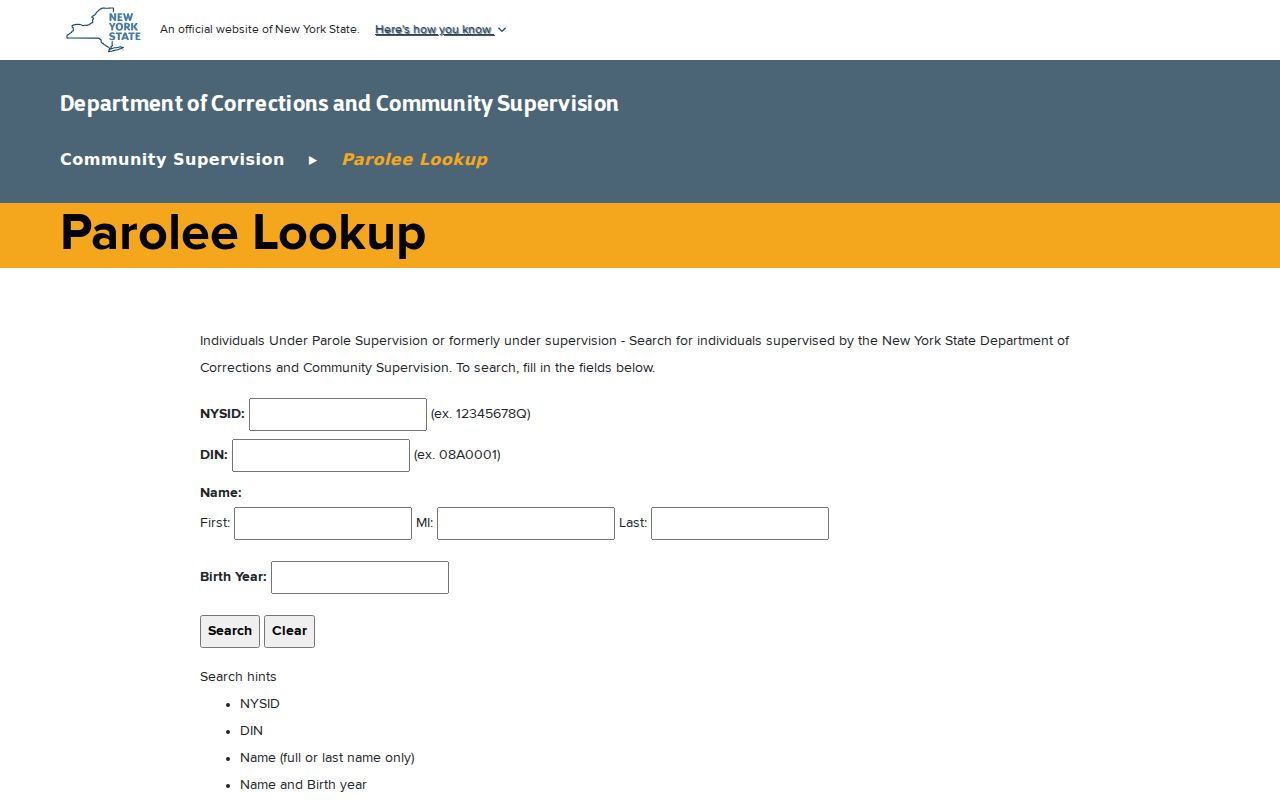
The state lookup becomes relevant only after the Cooperstown case reaches a sentence and DOCCS supervision, not during a new village booking.
Probation is different. Otsego County Probation, also at 197 Main Street, handles local community supervision and presentence work. Detailed supervision and presentence reports are not ordinary open docket attachments. The public court disposition may state the sentence without exposing the department's case notes.
Public Access Rules
Cooperstown Police and village administrative records use New York FOIL. Court files use Judiciary Law §255 instead. The distinction is practical: send a police report request to the village records officer, and ask the verified court clerk for filed charges or a disposition. DCJS official fingerprint histories remain restricted to the subject or attorney, while OCA CHRS is a separate public court-history search.
Key Statutes:
New York Freedom of Information Law governs access to existing village agency records, subject to exemptions.
Judiciary Law §255 directs court clerks to search, copy, and certify records upon proper request and payment.
Executive Law §837 establishes DCJS repository and dissemination duties.
CPL §160.59 provides an application route for sealing eligible convictions under statutory limits.
Expect lawful redaction and verify important results with the source. A police report is not a conviction record, a parking portal is not a criminal docket, and a county address does not make every file a county record.