
How to Check Criminal History in Oneonta
Start by deciding whether the event was a police contact, a filed court case, or a period in custody. No free Oneonta database joins all three. A name alone may also be too broad for the local clerks, so gather the date, location, report number, docket number, and date of birth when those details are known. The office that created the record can then confirm what it holds and whether inspection, a written request, or a certified copy is the right product.
- Contact Oneonta Police for a city incident or arrest report.
- Send a focused FOIL request through the Oneonta City Clerk when police staff direct the request there.
- Ask Oneonta City Court about filed local charges, appearances, and the disposition.
- Call Otsego County Corrections for current custody, or County Court for a transferred felony.
- Use OCA CHRS for a statewide public court search or DCJS Personal Record Review for your own fingerprint record.
A broad county overview can help when the correct custodian is unclear. The Otsego County criminal history route explains the limits of each county and state system.
Oneonta Police Records on Main Street
Oneonta city policing and court work meet at the Public Safety Building, 79 to 81 Main Street. The police general line is 607-432-1113, while emergencies go to 911. This shared location is useful, but it does not merge the files. Oneonta Police retains its own reports, and City Court retains accusatory instruments, dockets, orders, and dispositions. A request sent to the wrong counter may have to be redirected even though both offices occupy the same public-safety complex.
The official Oneonta Police Department page shows the city department and its contact route.
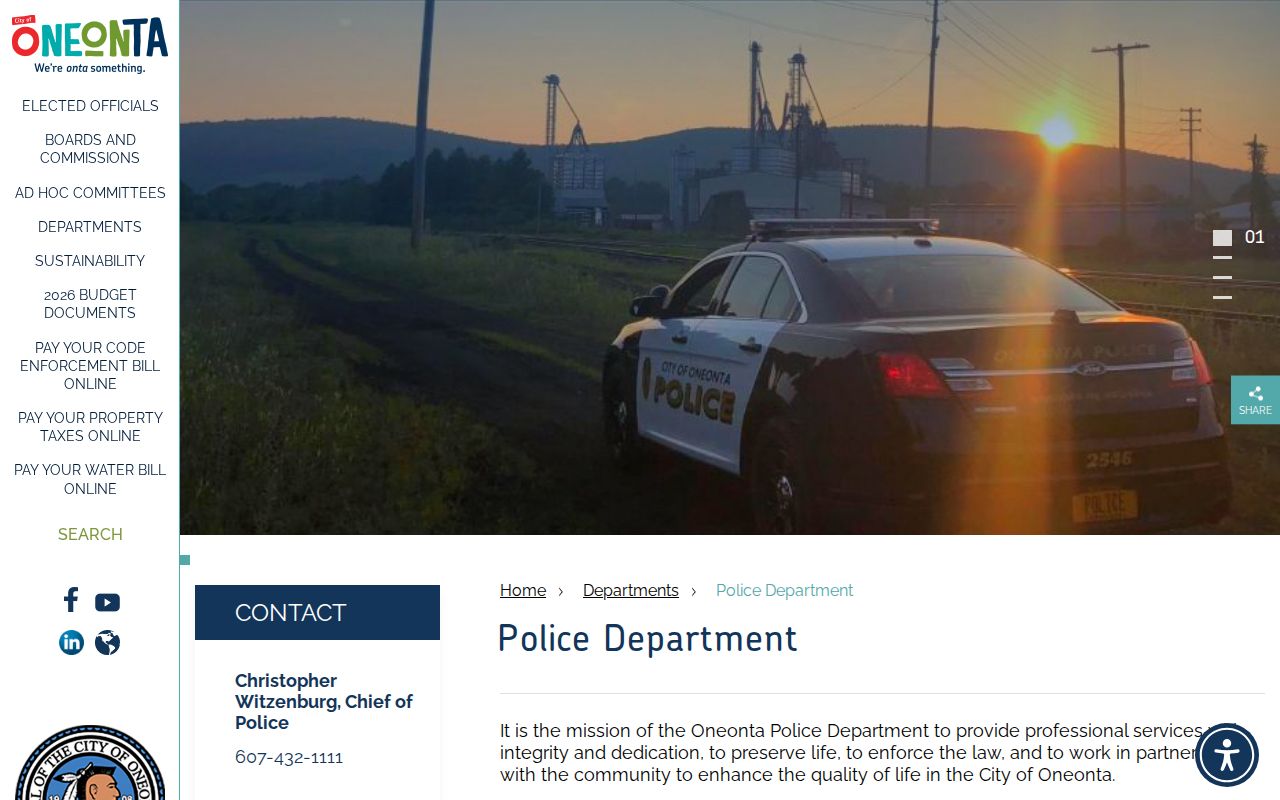
The image identifies the city police source to use before seeking any separate Oneonta court or county booking record.
The Oneonta Police Department
Oneonta Police creates incident and arrest paperwork for events handled by its officers. Ask for the exact artifact needed, such as an incident report, arrest report, photograph, or a defined body-camera segment. Include the event date and time range, address, incident or arrest number, and desired format. A clear request helps staff locate an existing record; FOIL does not require the city to answer questions or create a new report from several files.
Release is not automatic. Active-investigation concerns, fair-trial rights, victim or witness privacy, juvenile confidentiality, sealed matters, and protected personal details can support withholding or redaction. Oneonta criminal history from a police file reflects what officers recorded at that point. It does not prove the district attorney filed the same charge, nor does it show how a judge resolved the case.
Oneonta Criminal Records Through FOIL
Oneonta does not advertise a dedicated person-name police search or stand-alone public FOIL portal. The municipal fallback is the City Clerk, who serves as the city records administration contact. Describe Oneonta Police as the originating department, then give enough detail to identify the incident. Keep the police request distinct from a request for court papers, because the court does not process its files under city FOIL.
The Oneonta City Clerk page is the official municipal records contact.
This city contact supplies the practical fallback when a Oneonta police page offers no direct record search.
Ask for inspection when the needed pages are uncertain. A written response should explain any denial and the available appeal route. Segregable portions may still be released when only part of a Oneonta record falls within a lawful exemption.
Arrests and Bookings in Oneonta
Oneonta has no separate long-term city jail and no complete public booking blotter. When an Oneonta Police arrest results in detention, the person is taken into the Otsego County Corrections system at 172 County Highway 33W in Cooperstown. Call Corrections at 607-547-4252 for current custody. A releasable booking record may be requested from the Sheriff, while the police narrative remains with Oneonta and the filed criminal case belongs to the court.
These records can change at different times. The arresting officer lists the suspected offense, Corrections records intake and release, and a prosecutor may reduce, replace, or decline a charge. The court then records the charge actually filed and its outcome. For a fuller treatment of that sequence, use the county arrest history resource. A booking is evidence of processing and custody, not proof of guilt.
Finding Oneonta Court Records Without a Docket
The Oneonta Certificate of Disposition request is unusually useful when a docket number is missing. It accepts a subject name and aliases, date of birth, arrest number, criminal-justice tracking number, NYSID, incident or arrest date range, plate number, charge, and several other identifiers. The form also distinguishes a defendant or authorized agent from another requester and asks about identification or written authorization when sealed material is sought.
Give only identifiers tied to the right matter. The court uses them to locate a file; they do not expand what the law allows the clerk to disclose. A certificate is the concise, certified statement of how a Oneonta case ended. It is stronger proof of a local outcome than a police report or an uncertified statewide name-search result.
- Accusatory instrument
- The complaint, information, ticket, or felony complaint that starts the charge in court.
- Disposition
- The recorded result for a charge or case.
- CJTN
- A criminal-justice tracking number that can help match records across the arrest cycle.
Oneonta Municipal Court Records
The local court is formally Oneonta City Court, at 81 Main Street. Its criminal clerk can be reached at 607-376-5380. The counter is open weekdays from 8:30 a.m. to 4:30 p.m., except court holidays, and filings are not accepted after 4:00 p.m. The court hears misdemeanors, violations, local ordinance matters, and preliminary stages of felony cases before any transfer to Otsego County Court.
| Court Name | Oneonta City Court |
|---|---|
| Case Types Heard | City misdemeanors, violations, ordinances, and preliminary felony matters |
| Case Lookup Channel | Clerk phone or counter, eCourts/WebCrims where covered, and written request forms |
| What the Docket Shows | Charges filed, appearances, plea, case status, disposition, and sentence where public |
| Copies & Fees | Inspection is free; the clerk calculates copy charges before payment |
The general copy form lets a requester select an accusatory instrument, order of protection, or another named item. Mail requests need a self-addressed stamped envelope. Do not prepay, since the clerk first determines the page count and amount. Copies are furnished at the counter or by first-class mail, not by fax or email.
Oneonta Campus Criminal Records Stay Separate
Oneonta's two colleges make agency identity especially important. SUNY Oneonta is a state institution with its own records officer. Its FOIL contact is at 208 Netzer Administration Building, 108 Ravine Parkway, Oneonta, phone 607-436-2518. A campus record and an Oneonta Police record are not interchangeable. If more than one agency responded, request each agency's own report and use the incident number shown on its paperwork.
Hartwick College campus material may follow its institutional process, while the actual arrest record belongs to whichever authorized police agency made the arrest. This split also affects statistics. Oneonta's student population changes across the academic year, so resident census figures and police incident totals from a different period should not be combined into a casual safety claim. Use the same reporting year and label the agency behind each count.
Where Oneonta Records End Up
A fingerprintable Oneonta arrest begins with police paperwork and state tracking. If detention is ordered, Otsego County Corrections adds a booking record. Oneonta City Court records arraignment and local proceedings. An indicted felony moves to Otsego County Court, and the final court disposition is reported to the New York State Division of Criminal Justice Services. Reporting delays or a missing disposition can leave the systems out of step.
Record flow: Oneonta Police Department › Oneonta City Court or Otsego County Court › New York State Division of Criminal Justice Services
For recent activity, start with Oneonta Police, Corrections, and the court of origin. For your own full state-reported record, request an unsuppressed DCJS Personal Record Review through IdentoGO. Compare any incomplete arrest cycle with a certificate from Oneonta City Court, then use the DCJS challenge process if the repository still lacks the outcome.
When Oneonta Felony Records Move
A felony allegation may begin in Oneonta City Court on a felony complaint. The local court handles arraignment and early proceedings. After an indictment or superior-court information, the felony file proceeds to Otsego County Court in Cooperstown. Searching only Oneonta can therefore reveal the start but not the later case, while searching only County Court may miss the early local papers.
The district attorney prosecutes Penal Law and Vehicle and Traffic matters across Otsego County. The public defender page maps counsel assignments among County Court, Oneonta City Court, Drug Court, and local justice courts. Those offices do not operate public name-search databases, but their role explains why charging and defense documents may not appear in the police file.
The Otsego County District Attorney page identifies the prosecution office connected to Oneonta cases.
This county office becomes part of the Oneonta record trail when charges are reviewed or a felony advances beyond City Court.
Reading Oneonta Criminal Case Outcomes
Read the disposition for each charge, not just the arrest label. One arrest may contain several counts that end in different ways. A dismissal means a charge ended without conviction. An acquittal follows a not-guilty trial result. A conviction rests on a guilty plea or verdict, and the sentence is the consequence ordered by the judge. A certificate of disposition gives the clearest short record of that local outcome.
The Otsego County Public Defender page shows local court assignments and office contacts.
The assignment list reflects the real split among Oneonta City Court, County Court, Drug Court, and other local courts.
Presentence reports, treatment records, victim details, youthful-offender matters, and sealed files are not ordinary public docket material. A clerk can explain copy mechanics but cannot interpret the legal effect of an outcome. Someone reviewing their own Oneonta criminal record should seek counsel when the entry affects rights or when eligibility for sealing is uncertain.
Oneonta Court Access at the Counter
Oneonta City Court visitors pass through a magnetometer. The building has nearby accessible parking, a ramp, automatic main doors, elevators to public floors, and accessible second-floor restrooms. Accommodation requests should be made several days ahead through the District Executive at 607-240-5350. Because no countywide policy confirms lockers or the handling of recording devices, call the clerk before bringing equipment.
At the window, identify the case and ask to inspect before choosing copies. Inspection can prevent the cost and delay of ordering an entire file when only an accusatory instrument or disposition is needed. For mailed requests, select the exact document, supply the contact fields, sign and date the form, and include the required return envelope. Oneonta's 4:00 p.m. filing cutoff matters for filed papers, even though the public counter remains open later.
Public Access Rules
Oneonta Police and city administrative records are requested under the New York Freedom of Information Law. Filed court records take a different path under Judiciary Law §255. DCJS fingerprint histories are restricted to the subject or the subject's attorney, while OCA CHRS offers a separate public exact-name and date-of-birth court search. These boundaries prevent one request from serving as a universal Oneonta criminal history check.
Key Statutes:
New York Freedom of Information Law provides access to agency records subject to statutory exemptions.
Judiciary Law §255 governs court-clerk searches, copies, and certifications upon proper request and payment.
Executive Law §837 establishes DCJS repository and dissemination functions.
CPL §160.50 restricts access after a qualifying favorable termination.
Ask the right custodian and expect lawful redaction. A public police report may omit protected details, a sealed court file may not be available, and an OCA result may exclude old or nonreportable local matters. Verify any important Oneonta outcome with the court that entered it.