
Criminal Cases in the Otsego County Courts
Otsego County Court has exclusive trial authority over felonies and shares misdemeanor jurisdiction with local courts. A felony complaint may start before a city, town, or village justice. After an indictment or superior-court information, the felony file moves to County Court at 197 Main Street, Suite 9, Cooperstown. Misdemeanors, violations, and ordinance charges may stay where they began. Oneonta City Court handles city misdemeanors and violations as well as early felony proceedings. Cooperstown and Richfield Springs justice courts, plus town courts, keep their own local dockets.
This division matters more than the county name on an arrest form. Searching only the Cooperstown felony court can miss a pending Oneonta misdemeanor or a town-court disposition. The clerk of each court holds its docket, charging papers, orders, plea, judgment, and certificate of disposition. Otsego County Court can be reached at 607-322-3140. Oneonta City Court's criminal clerk is at 607-376-5380. For another local court, use the official New York Court Locator and confirm the current clerk and session before sending a request.
Oneonta Court Copies in Otsego County
Oneonta City Court offers a written copy route that is unusually clear. Its form lets a requester select an accusatory instrument, an order of protection, or another named document. The requester supplies a printed name, mailing address, telephone number, date, and signature. For mail service, include a self-addressed stamped envelope and do not prepay. The clerk first counts the pages and sends the amount due. Inspection at the court window is free, while copies are sent in person or by first-class mail, not by fax or email.
The official Oneonta City Court page shows the court and its local access details.
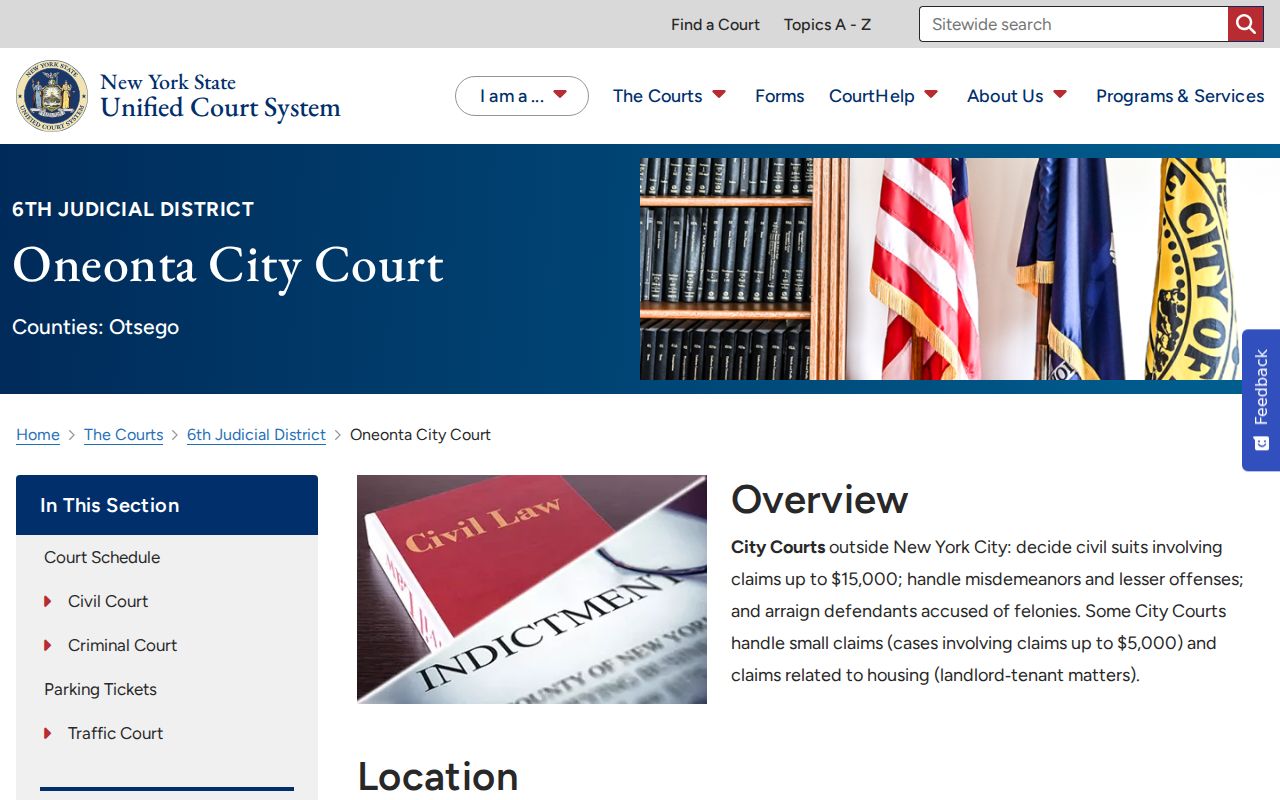
The court page helps a searcher identify the right clerk before using the written form or visiting the Public Safety Building counter.
How to Search Case Records
Begin with New York eCourts/WebCrims for a preliminary look at participating current criminal matters. The online result is a lead, not a certified outcome. Use a docket number when available. With a name search, compare the court, filing date, and charge details before assuming a match. For a broad public name-and-date-of-birth search, OCA Criminal History Record Search Direct Access covers qualifying statewide court history for $95 per exact combination.
- Identify the likely court from the charge location, appearance ticket, or arraignment papers.
- Search WebCrims by defendant name or case number and review the case detail and calendar entries.
- If the case is missing, call the court clerk with the name, date of birth, charge date, and any known identifier.
- Inspect the file or request the specific charging paper, order, docket entry, or disposition needed.
- Order a Certificate of Disposition when a certified statement of the outcome is required.
OCA CHRS uses the following exact-match inputs. An alias or alternate birth date is a separate paid search.
| Field Label | Type | Required | Notes |
|---|---|---|---|
| Subject Last Name | Text | Yes | Exact spelling; variations are not included. |
| Subject First Name | Text | Yes | Use the full submitted first name. |
| Middle Name or Initial | Text | If known | Exact matching can change the result. |
| Alias | Text | No | Each alias is another $95 search. |
| Date of Birth | Date | Yes | Each alternate date is a separate search. |
| Return Method | Choice | Yes | Email or mail with a stamped return envelope. |
Why Otsego County WebCrims Misses Cases
A blank WebCrims result does not prove that no Otsego County court case exists. Participation and current data can differ by court, and older town or village matters may require a clerk search. OCA CHRS has its own historic gap: town and village data is absent from May 1991 through 2002, limited from 2002 through 2007, and broadly complete only from May 2007. CHRS also omits sealed matters, specified marijuana cases, youthful-offender material, noncriminal violations, and other listed categories.
The official court records and case information guide explains why online search, clerk access, and CHRS serve different needs.
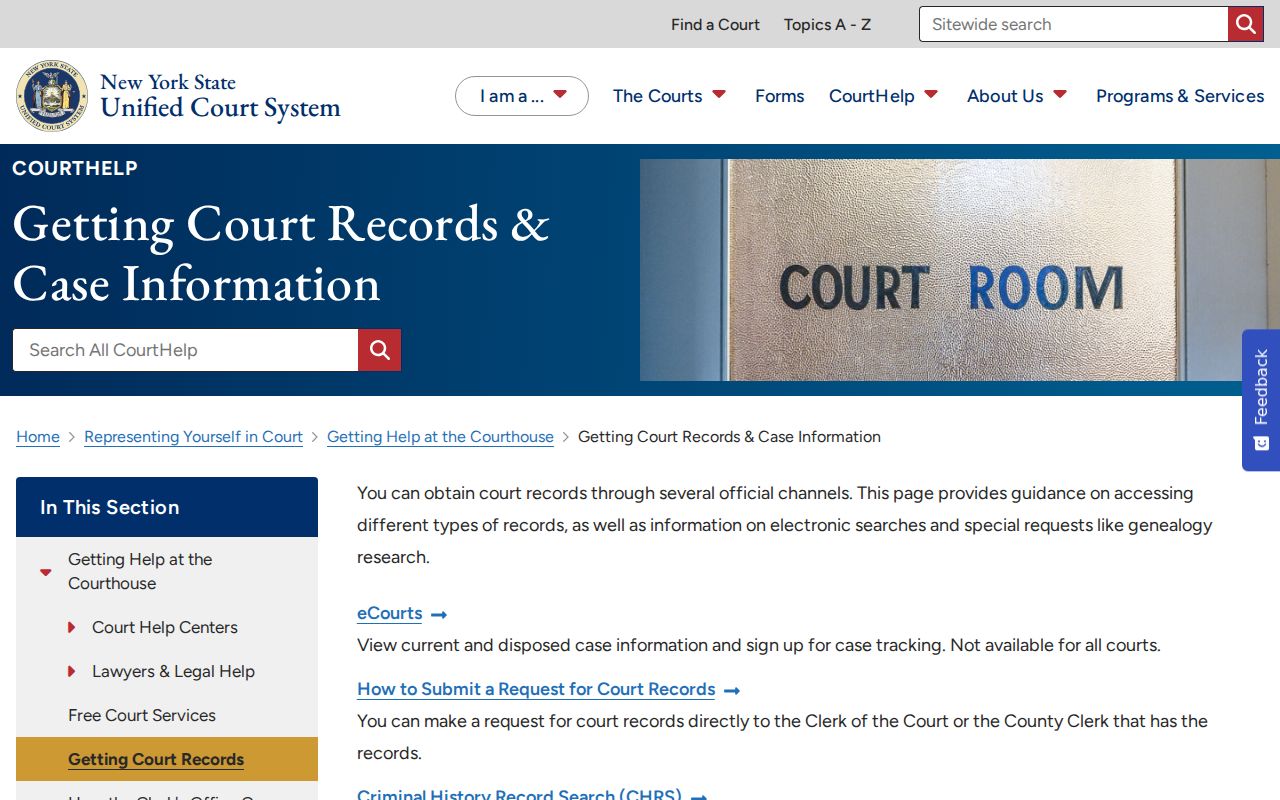
Its route back to the court clerk is vital in Otsego County, where local case files are spread among many separate courts.
Note: A no-result screen reflects one database and its rules, not a finding that no Otsego County case ever existed.
What the Case File Shows
A public Otsego County criminal case file traces what prosecutors filed and what the court did. It is not the same as an officer's arrest report or a fingerprint-based DCJS rap sheet. The docket may show several charges from one event, and each charge can end in a different plea, dismissal, verdict, or sentence. A certificate of disposition gives concise proof of a particular court outcome, while the full file can show the steps that led there.
| Case Number and Court | Identifies the court of origin and its docket or indictment file. |
|---|---|
| Charging Document | Shows the complaint, information, felony complaint, or filed indictment. |
| Docket Entries | Lists filed papers, appearances, motions, orders, and status changes. |
| Hearing Dates | Records past appearances and scheduled proceedings when public. |
| Disposition and Judgment | States how each charge ended through plea, verdict, dismissal, or acquittal. |
| Sentence and Conditions | May show custody, probation, fines, surcharges, restitution, or protection orders. |
Full dates of birth, Social Security numbers, victim data, grand-jury minutes, sealed papers, and confidential reports are not ordinary public-view fields. An online summary may also reveal less than the paper file.
Otsego County Cases Without Docket Numbers
A missing docket number does not end the search. Oneonta's Certificate of Disposition request form accepts a wide set of clues: full name and aliases, date of birth, arrest number, complaint number, criminal-justice tracking number, NYSID, incident or arrest date range, plate number, charge, and even a partial docket number. Those fields show why a short, precise request works better than asking a clerk for every record tied to a common name.
Give the Otsego County clerk the strongest identifiers you lawfully have. State the type of document sought and whether inspection will be enough. If the case began as a felony complaint in a local court, ask whether later records moved to County Court. When a court file and a personal DCJS record disagree, obtain the certificate from the court of origin, then use the DCJS challenge route to correct an incomplete arrest cycle or missing disposition.
Stages of a Criminal Case
An Otsego County felony often starts in a local court, even though County Court will try it. Arraignment addresses the charge and release conditions. Prosecutor review may lead to an information or grand-jury presentation. After indictment, County Court holds another arraignment. Discovery, motions, conferences, hearings, a plea or trial, sentencing, and a possible appeal then create distinct docket entries. A misdemeanor can remain in Oneonta City Court or another justice court throughout.
Case flow: Charges Filed › Arraignment › Pretrial › Plea or Trial › Disposition › Sentencing
The stages explain why an early booking charge and the final Otsego County disposition may not match. The filed accusatory instrument controls the court case, and later amendments, reductions, or dismissals appear in the docket.
Otsego County Court Reports Versus Certificates
An OCA CHRS report and a Certificate of Disposition answer different questions. CHRS searches qualifying public court history across New York by an exact name and date of birth. It is useful when the originating Otsego County court is unknown, but it is not fingerprint matched and is not certified. A certificate comes from the clerk of the court that decided one case. It is the concise, certified account of that docket's outcome.
CHRS can list court, case number, arrest or filing date, charges, disposition, and sentence data sent to OCA. It excludes several record classes and can miss a name variation. For formal proof of one Otsego County case, use CHRS as a locator and then contact the named clerk. The broader Otsego County criminal history overview explains when a personal DCJS fingerprint review is the better tool.
Access & Restrictions
New York court records do not use the Sheriff's FOIL form. Judiciary Law §255 directs court clerks to search, copy, and certify court records upon a proper request and payment. Police and Sheriff files instead follow the New York Freedom of Information Law. Sending a court-record demand to the Sheriff delays the search because the Sheriff does not hold the clerk's docket or disposition certificate.
Sealed cases, youthful-offender adjudications, juvenile matters, victim details, medical information, and protected identifiers can be withheld or redacted. A favorable termination generally triggers sealing under CPL 160.50. Other statutes govern eligible conviction sealing and the Clean Slate process. If a known Otsego County case does not appear online, ask the clerk whether the file is sealed, off site, filed under a different spelling, or held by another court. Clerks can explain access and filing mechanics, but they do not give legal advice.
Otsego County Treatment Court File Limits
Otsego Treatment Court is a named local program, but its presence on a docket does not make every related report public. The Otsego County Probation Department prepares presentence reports, handles restitution, and works with treatment courts. Presentence investigations and detailed supervision records are not ordinary public docket attachments. A public case file may note a referral, court appearance, disposition, or sentence without exposing clinical, family, or confidential assessment material.
Ask the Otsego County court clerk for the public docket and filed orders rather than a probation case file. If a docket says a presentence investigation was ordered, that phrase describes a step before sentence, not a promise that the report can be inspected. Defense counsel can explain confidential case material to a client, while the public counter can identify only what the law permits it to release.